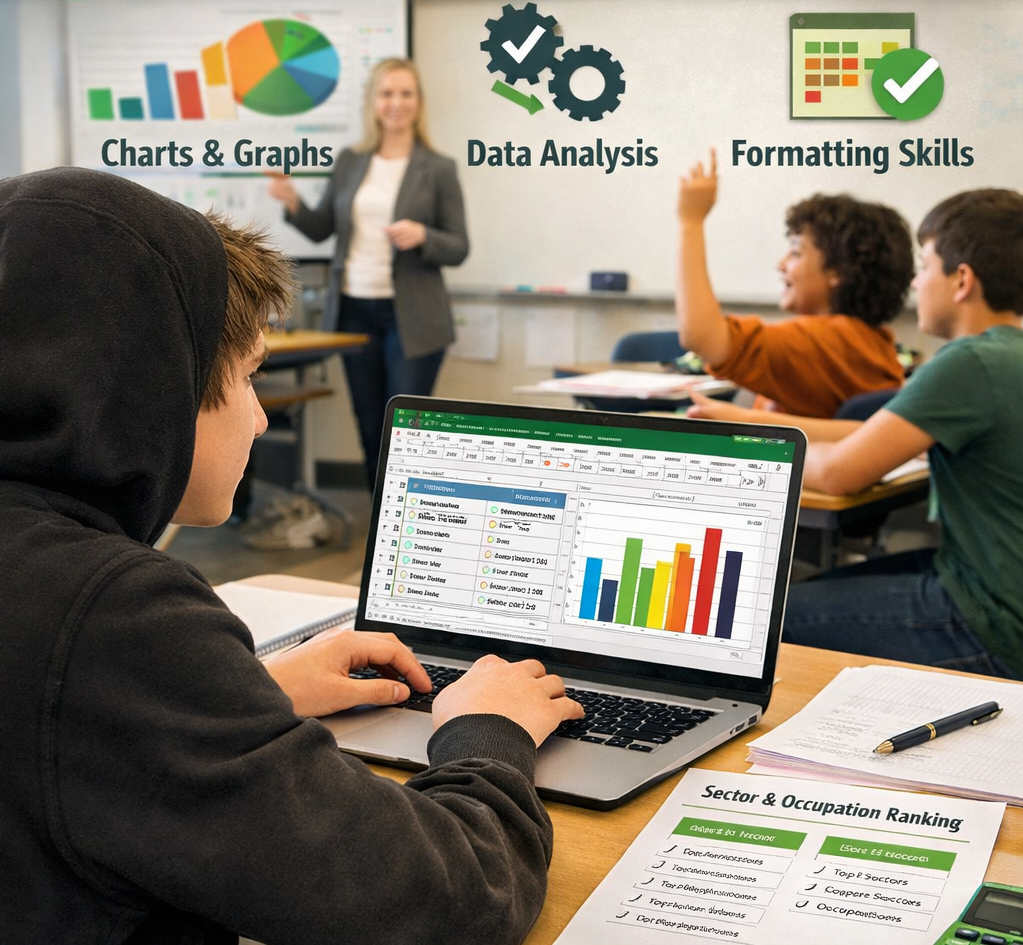
This week, my 15-year-old is preparing to write their final exam in a high school business class. Watching them study has made me reflect — not just as a parent, but as a college professor who has taught business, entrepreneurship, and project management for years.
If there is one skill I wish every high school business student graduated with, it’s this:
A solid, confident foundation in Excel.
Not “I’ve opened it once.”
Not “I filled in a table.”
But real, practical, transferable Excel skills.
Excel Is Not Optional in Post-Secondary Education
In every college business program I’ve taught, Excel is assumed knowledge — whether it’s explicitly stated or not.
That’s why, in my college courses, the very first graded assignment is always an Excel assessment.
Not to intimidate students.
Not to “weed anyone out.”
But to understand where they are and help them succeed.
My First Assignment: Getting to Know You (and Your Excel Skills)
The assignment itself is intentionally low-pressure and highly flexible.
I give students:
- NAICS codes (industry sectors)
- NOCS codes (occupations)
- Clear definitions for both
Then I ask them to:
- Rank the sectors they are most interested in working in → least interested
- Rank the occupations they are most interested in → least interested
That’s it.
But here’s the key part:
I ask them to complete it entirely in Excel, using any formatting they want.
What I’m Actually Assessing
I tell students up front that they are not being graded on choosing the “right” sector or occupation. Instead, I’m evaluating:
- Basic data organization
- Use of tables
- Formatting choices
- Charts and graphs
- Conditional formatting
- Sorting and ranking logic
- Overall clarity and readability
Some students submit beautifully formatted spreadsheets with charts, colour scales, and clean layouts.
Others submit something closer to a Word document pasted into Excel.
Both submissions tell me something valuable.
The Confidence Gap Is Real
What I’ve seen year after year is this:
Students who learned Excel earlier — even at a basic level — walk into post-secondary programs with confidence.
Students who didn’t often feel behind before the course has even really started.
Excel isn’t just software. It’s a language of business.
And like any language, the earlier you start learning it, the more fluent you become.
Excel Teaches More Than Just Excel
This is why Excel belongs in high school business classes:
- It teaches logical thinking
- It reinforces math and data literacy
- It supports career exploration
- It builds confidence with technology
- It prepares students for college and the workplace
Students don’t need to master advanced formulas in high school.
But they do need exposure.
They need to understand that:
- Data can be structured
- Information can be analyzed
- Ideas can be communicated visually
These are lifelong skills.
Career Awareness Starts Earlier Than We Think
One of my favourite outcomes of the NAICS/NOCS assignment is the conversation it sparks.
Students often say:
- “I didn’t know this job existed.”
- “I thought this industry was something else.”
- “I never realized how many options there were.”
Excel becomes the tool, but career awareness becomes the lesson.
That’s powerful — especially for students who may not yet see how business education connects to their future.
A Message to High School Business Educators
If you teach high school business, you are laying the foundation.
You don’t need to turn students into Excel experts.
But you can give them something far more important:
Comfort. Familiarity. Confidence.
Introduce spreadsheets early.
Let students explore formatting.
Encourage charts and visuals.
Make it okay to experiment.
Those small experiences make a huge difference later.
From One Parent and Instructor to Another
As my teenager prepares for their exam, I’m grateful they’ve had exposure to business concepts early on.
And as a professor, I can tell you this with certainty:
Students who arrive knowing Excel — even just the basics — start stronger, stress less, and succeed faster.
That’s a win for students, educators, and future employers alike.
If we want to prepare students for what comes next, Excel belongs in high school business classrooms.